Monday, 14 October 2013

Ephesus

Today we went to the ancient city of Ephesus.   Welcome to Turkey.  We do not expect to see as much development here.

We went off via the gangways, onto waiting buses, all 1000 passengers!  Very impressive organisation by cruise staff, with a minimum of waiting time and fuss.


In Turkey, agriculture is fairly big industry including citrus, olives, and also cotton production.  There are also horses, goats, cows and sheep, but not much pork as the country while secular, is mostly Muslim.

Ephesus was founded by the Greek prince Androclus, on the site of the Oracle of Delphi,  ?myth or legend, 3000 years ago, the Hittites were among the original inhabitants of the site.  Ephesus was originally a port town however the harbour eventually silted up, this led to a malaria outbreak, many perished and the city was eventually abandoned.


This is an example of the Roman built baths, with a sophisticated series of rooms designed for the process of bathing as you did then.  Ephesus had an advanced aqueduct system with terracotta pipes carrying water where it needed to go. Another advanced thing was dumb waiters in restaurants.


Here you can see the original marble street, which have grooves cut into them to prevent slipping.

St Paul made three visits to Ephesus, and preached in many places during his time there.  This monument, the Nymphaem Traiani has links to Paul, which I would need to research for facts.  The round marble figure resting on the table, suggests the ancient Greeks knew the world was round.

Hadrian keeps popping up in this trip and this is his temple.


Here are public toilets only for men.  Built out of marble, a little bit cold as you can imagine, not to worry.  They had slaves whose job it was to warm the seats by sitting on them themselves.  These toilets had a flushing system, and also music to drown out those unpleasant toileting sounds.


Next along the road we came to the terrace houses.  These were residences built into the slope of the hill and were an ancient times block of units.  Terrace 1 for example, was a group of 6 unit houses built around a central courtyard area.  Inside, they were decorated with frescoes, so named because the paint was applied while the plaster was wet, and had complex mosaics on the floors.


Local marble on the walls, and the central courtyard, with a altar in it.
  
 
More quilt inspiration.


The ladies room.


More amazing mosaics, which were in many rooms.


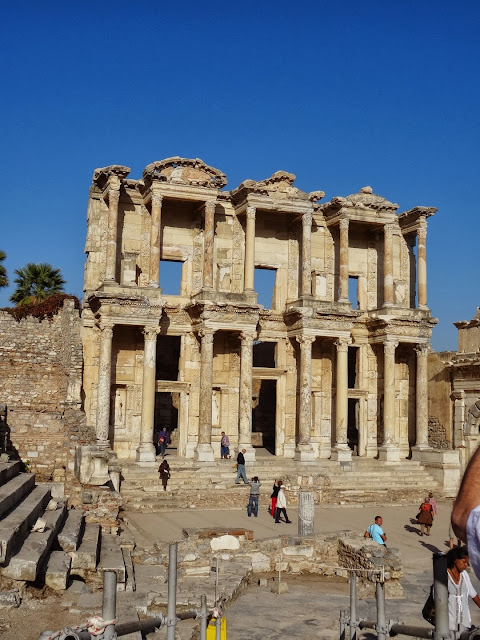
Moving on from the houses we came to the ruins of the Library of Celsus which is the third oldest building, built in 200 BC.


This is a processional way where Marc Antony and Cleopatra are said to have processed.


This is the Grand theatre built in third century BC.  The Romans enlarged and modernised during their time there.  There was a 25,000 seat capacity, the stage building was three stories, and 18 metres high.


This was on our way to Turkmans carpets on the outskirts of Kusadasi.


We were able to watch a demonstration on the double knot technique  they use when making the carpets out of wool, or silk as in the picture above.

And then how tempting to buy one, shipping is free as it is a trade supported by the Turkish government., but which one do you choose?


Then back to the ship for some more R and R.


Not too much time to rest however as back on an excursion to Patmos, this time instead of the gangway, we were ferried across on tender boats, yes another boat!  These boats just parked alongside the cruise ship and you went down via some steps.
 

The Monastary of St John is in a fortress like building. It is a Greek Orthodox, founded in 1088 in Chora, located next to the Grotto where St John is said to have had his visions and God spoke to him, and he wrote the Book of the Revelations.  There is much history here, ST John is said to have been extremely old at his death, 95-104, depending on who you talk to, and he spent his last years in exile here  from the age of 75.


 We  could not take photos inside, but could take photos of these ancient frescoes and mosaics
 which  give you some of the idea of what it was like inside.


Inside the museum there were many icons and ancient manuscripts written by hand onto parchment of lamb or goatskin. 

 Further down the hill,  was the Grotto of St John, and Chapel of Anna built into the rock.  It was essentially a big cave, high enough to stand up in.  There was a ledge on which the scribe wrote down what St John was dictating, and also a niche in the rock where John would lay down his head on the rock pillow to rest. Beside this was a  handgrip which John would use to pull himself up after praying and meditating.  Up above there are three fault lines in the rock through which God's voice is said to have come through telling John what to write.

This is the town centre, where there are shops and cafes.


Back to the Ship....


For some more of this.....


Cruising the Greek Islands

Up early today to board our cruise ship for the next three days.  This is the highlight of the trip, i know I keep saying that about everything, but what fun is this?


The ship.


Our lifeboat, lucky 7.


Not quite the Titanic pose, but as close as I'm going to get to the front of the ship.

This is so much fun. I have always wanted to do this  ever since watching the Love Boat, which is a bit weird considering my sailing on boat phobia.  They have "love boat " music playing as I write.  Lucky for me, the sea is flat and I have had no problems requiring a bucket.  When you are not eating,( there is so much food), you can be at the pool, watching a greek food cooking class, or having a salsa dance lesson.  As I write this, I am sipping on an Aegean fruit smash, a mocktail containing banana, pineapple and juice, ice and milk.  My other favourite is a Pina Colada.


Our first Greek island visit was Mykonos, the island of white houses and blue shutters, and it did not disappoint. 


And it just got better.


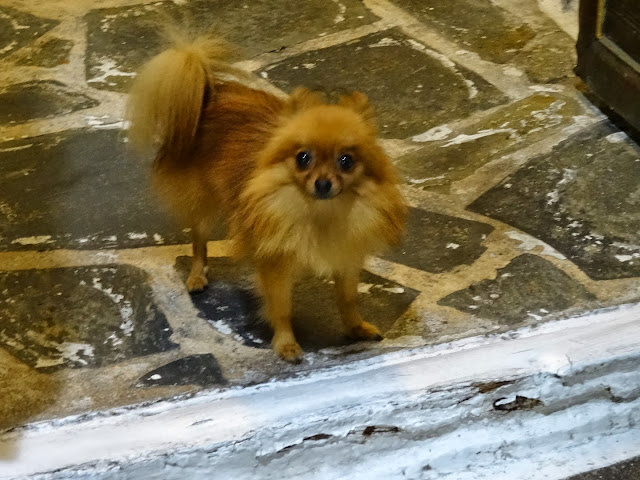
Some of the local canine community.


And these breathtaking views.


More stunning views.. We only had daylight for about one hour, so had to walk fast to make the windmills in time.  These are the ones you see on postcards.


And then at night.....this.  Just beautiful.  How lucky are we to see this.


Back to the ship for more eating.


The Parthenon


This is where we were on Thursday.  The Acropolis in Athens, can you believe it.  Unfortunately skies overcast and a bit of rain, but even without the blue sky behind it, stunning nevertheless.


Three hills are important in Athens. They include Philopappos Hill, Mars Hill and then north west to Philopappos, Hill of the Nymphs.  Photo above is  Philopappos Hill, also known as the Hill of Muses from which poets, artists were supposed to have received their inspiration.  This is the hill from which the Turks in 1687, fired a cannon which landed in the middle of the Parthenon, damaging it badly.


Mars Hill, or Areios Pagos, the Hill of Justice, is the site from which St Paul preached, and later where Greeks had assemblies, and  where the democratic process was evolved.


And then you make your way up to this.  This is as i probably don't need to tell you is the Parthenon, the temple which the Greeks dedicated to their Goddess Athena, who was the deity for wisdom. The two earlier buildings on the same site began as early as 447 BC,  and then the decoration took another 9 years to finish.  Engineering of the time shows Doric columns , wider at the base, leaning slightly inwards, with different sizes and spaces aimed for greater structural strength.  Over the years however, destruction occurred by earthquakes, enemies such as the Turks and also the  Christians, who when they claimed the buildings for their own worship, destroyed the decorations of the Deities etc because they were pagan.


Restoration  is going on all the time following the 50/50 rule.  Using more than 50% of non original materials is considered reconstruction rather than restoration, and they are careful to avoid this.  You can see in this picture where new marble has been added to the structure, they are the lighter bits.


From the top of the hill( acropolis), you can see the Temple of Zeus.


Also on the way is the Theatre of Dionysius, which is still in use today in the Summer months only, Pavarotti performed there, just to name one great performer.. See  Philopappos Hill in the background.


A panoramic view from the top of the Acropolis.

We got off the bus after the tour ended, and walked around the Flea Markets, which were not so flea! Then we had a walk through Plaka, one of the oldest areas of Athens.


We then walked to the Acropolis Museum, which is a delightful blend of the Old and the New.  For instance, below shows you the remnants of the sculptural frieze which went around the top of the Parthenon.  It has been restored in places, and then displayed shown below so that you get a feel for what the size was.  This building contains all the artifacts found on site.


This is a model of the sculptural decorations displaying scenes from ancient myths in one of the pediments the parthenon.  You can make out Poseidon in the middle holding his "pitchfork".


Time to say goodbye to the people not going on the cruise extension part of the trip.


This is where we had our farewell dinner.  Greek food included a mezze platter, cheese pie, spanokopita, dolmades and some sausage, followed by pork or chicken yiros.  Dessert was fresh fruit.