Monday, 14 October 2013

Cruising the Greek Islands

Up early today to board our cruise ship for the next three days.  This is the highlight of the trip, i know I keep saying that about everything, but what fun is this?


The ship.


Our lifeboat, lucky 7.


Not quite the Titanic pose, but as close as I'm going to get to the front of the ship.

This is so much fun. I have always wanted to do this  ever since watching the Love Boat, which is a bit weird considering my sailing on boat phobia.  They have "love boat " music playing as I write.  Lucky for me, the sea is flat and I have had no problems requiring a bucket.  When you are not eating,( there is so much food), you can be at the pool, watching a greek food cooking class, or having a salsa dance lesson.  As I write this, I am sipping on an Aegean fruit smash, a mocktail containing banana, pineapple and juice, ice and milk.  My other favourite is a Pina Colada.


Our first Greek island visit was Mykonos, the island of white houses and blue shutters, and it did not disappoint. 


And it just got better.


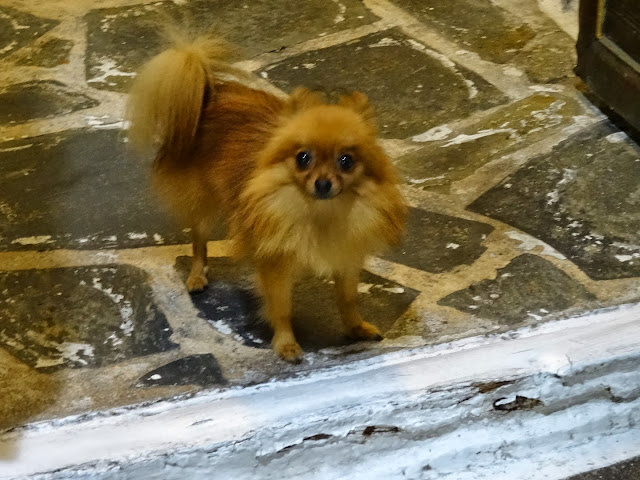
Some of the local canine community.


And these breathtaking views.


More stunning views.. We only had daylight for about one hour, so had to walk fast to make the windmills in time.  These are the ones you see on postcards.


And then at night.....this.  Just beautiful.  How lucky are we to see this.


Back to the ship for more eating.


The Parthenon


This is where we were on Thursday.  The Acropolis in Athens, can you believe it.  Unfortunately skies overcast and a bit of rain, but even without the blue sky behind it, stunning nevertheless.


Three hills are important in Athens. They include Philopappos Hill, Mars Hill and then north west to Philopappos, Hill of the Nymphs.  Photo above is  Philopappos Hill, also known as the Hill of Muses from which poets, artists were supposed to have received their inspiration.  This is the hill from which the Turks in 1687, fired a cannon which landed in the middle of the Parthenon, damaging it badly.


Mars Hill, or Areios Pagos, the Hill of Justice, is the site from which St Paul preached, and later where Greeks had assemblies, and  where the democratic process was evolved.


And then you make your way up to this.  This is as i probably don't need to tell you is the Parthenon, the temple which the Greeks dedicated to their Goddess Athena, who was the deity for wisdom. The two earlier buildings on the same site began as early as 447 BC,  and then the decoration took another 9 years to finish.  Engineering of the time shows Doric columns , wider at the base, leaning slightly inwards, with different sizes and spaces aimed for greater structural strength.  Over the years however, destruction occurred by earthquakes, enemies such as the Turks and also the  Christians, who when they claimed the buildings for their own worship, destroyed the decorations of the Deities etc because they were pagan.


Restoration  is going on all the time following the 50/50 rule.  Using more than 50% of non original materials is considered reconstruction rather than restoration, and they are careful to avoid this.  You can see in this picture where new marble has been added to the structure, they are the lighter bits.


From the top of the hill( acropolis), you can see the Temple of Zeus.


Also on the way is the Theatre of Dionysius, which is still in use today in the Summer months only, Pavarotti performed there, just to name one great performer.. See  Philopappos Hill in the background.


A panoramic view from the top of the Acropolis.

We got off the bus after the tour ended, and walked around the Flea Markets, which were not so flea! Then we had a walk through Plaka, one of the oldest areas of Athens.


We then walked to the Acropolis Museum, which is a delightful blend of the Old and the New.  For instance, below shows you the remnants of the sculptural frieze which went around the top of the Parthenon.  It has been restored in places, and then displayed shown below so that you get a feel for what the size was.  This building contains all the artifacts found on site.


This is a model of the sculptural decorations displaying scenes from ancient myths in one of the pediments the parthenon.  You can make out Poseidon in the middle holding his "pitchfork".


Time to say goodbye to the people not going on the cruise extension part of the trip.


This is where we had our farewell dinner.  Greek food included a mezze platter, cheese pie, spanokopita, dolmades and some sausage, followed by pork or chicken yiros.  Dessert was fresh fruit.


Thursday, 10 October 2013

Athens

 We arrived in Athens yesterday late afternoon.and are staying at the best Hotel so far of our trip,  Why? Because it has a kettle, and what a luxury to make your own cup of tea.  There is a supermarket around the corner, so i bought some real milk because we have a fridge too, well a mini bar.  You don't get milk very often with tea in Europe.

In the morning we visited the archaeological site of Mycenae.  This was a civilisation evolved in the 16th and 12th century BC and covered the Mediterranean basin, but excavations have shown that habitation was here also as early as the 3rd millennium BC.


 Not so easy to see in this picture, but can you see on the drier mountain in front the ruins of the acropolis?  The acropolis of the house of the  Attreidaes was well placed overlooking the region and was able to control communication routes throughout the Peloponnese and to mainland Greece. The earlier peoples are suspected to be Perseus and his descendants in the middle Helladic period which was 1900-1580 bc.


This is some of the valley the acropolis overlooked


Getting down to the nitty gritty, how on earth did those early civilisations move such massive stones to build their walls?


Those blocks were part of structures like these, the Cyclopean walls, which were approx 900metres long, 5.5-7.5 metres thick and up to 12 metres high.


This is the other side of that wall, called the Lions Gate which is the main entrance to the citadel.  The missing lions heads were possibly made of some precious metal, plundered years ago.  Lions were used as symbols   to represent power and domination.


Another remarkable feat of engineering which I am sure those modern day engineers amongst us will appreciate, is the cistern which was built inside the city in order to supply fresh water in times of siege. These are the steps leading down and going a further 60 metres underground.  Too dark down there to go further.


These are the Grave circles, the royal tombs.


The Museum on site which unfortunately we were rushed through, displays many artefacts found on site.  This is a display of early implements of hair and makeup.  Note the tweezers, bottom left hand corners.


These are some of the characters of the script used at the time.


More for the engineers.  This was a beehive tomb, which some people believe was the tomb of Agamemnon.  Note the lintel across the opening.


Inside, it is obvious why it is called a beehive tomb.  The guide pointed out the crack in the stone lintel on the right hand side.  The reason it did not crack in the middle over the doorway during earthquakes is the triangular gap above the doorway.


Another view from the top.  We would have loved to spend more time at this site, but sadly the bus was waiting.


This is a atm we found during the lunchtime break.


Yet another example of early engineering, the Corinth Canal, which after numerous early attempts, the emporer Nero apparently turned the first sod with a golden pickaxe.  The goal was to cut through the narrow Isthmus of Coritnth literally between the Gulf of Corinth and the Saronic gulf in the Aegean to save navigation time around the Peloponnese.  It was completed in 1893, after a lot of failed attempts because of geological and financial problems.  it is excavated down to sea level , so lochs are not needed, however it is narrow and not very deep, so is really only suited to barge type vessels.  It was damaged during WW2 but then repaired.


So after all this adventure, time to arrive in Athens.  We found some food, apparently french fries are universal!


We ate it all up anyway.

Wednesday, 9 October 2013

Tolon

Yesterday was a  short day on the bus.  When we got off the ferry at around 2.30, it was straight onto the new bus and driving to Olympia.


Our initial impression of Greece was that of a fairly rundown, depressed place.


But then we drove through some really beautiful countryside.


We had the best meal of our trip so far, with well cooked food and fantastic flavours.  Dishes included a baked feta cheese pie, roasted eggplant, sundried tomatoes and crumbled feta cheese, meatballs like kofta, roast pork, rosemary potatoes, and lovely salads such as beet root, tomatoes. Dessert was fresh melon pieces, a chocolate cake and milk pie, not sure what was in the middle of that, but there was pastry on top and bottom and then a sugar syrup similar to that of baklava over the top.


Then we went for a walk down the street and shops were open with salesmen eager to sell things to us. 

This morning we visited the ruins of Olympia, where the Olympic Games began.


This was our tour guide and she gave really great insight into the beginning of the games.  About how the games evolved before there were organised sport as we know it today.  Rather they were a religious activity, a celebration and a tribute and commemoration  to and of the Gods of their time Eg Zeus and Hera.  

She pointed out how they were a symbol of peace as any wars being fought at the time were simply put aside, and the games begun.  It didn't matter which Greeks were fighting which other Greeks, they were all from the one country, and all went to the games, putting their differences aside.

The concept of victory was also different.  The athletes would have been in the elite fighting forces, and would have been at the forefront of any battles, so winning at the games was also about defending their country's honour.


This was the archway leading into the stadium.


Some of the ruins, the Philippeion, which was a circular building, started by Phillip II of Macedonia and completed by his son, Alexander the Great, it had 5 statues of Alexander and his ancestors.


Some more excavations going on. 

Then we went and had a look at the Museum which houses the artefacts found on site.


After Olympia, we drove to Tolon  going up through the mountains, which was pretty spectacular.


and then we had our first look at the Aegean.


We saw some blue skies for the first time .  This is the beach close to where we are staying.


And that was another day finished.